
E1 House of Books
Course No.: 848106
Teaching: Catalina Tripolt
Course No.: 848106
Teaching: Catalina Tripolt

848156 – EX Exkursion
Studio Colletti
September 2026
Die Architekturexkursion nach Ecuador (voraussichtlich September 2026) untersucht das Zusammenspiel von Geografie, Klima, Materialkulturen und urbanen Transformationsprozessen zwischen Andenhochland und Pazifikküste. Im Fokus stehen Stadt- und Landschaftsräume, öffentliche Bauten, Wohnformen sowie informelle und resiliente Strategien des Bauens. Vor Ort kombinieren wir geführte Besichtigungen, Gespräche mit lokalen Akteur:innen sowie kurze Analyse- und Skizzenübungen. Ziel ist es, räumliche, konstruktive und kulturelle Bedingungen aus erster Hand zu lesen und kritisch in eigene architektonische Positionen … more

Course No.: 848155
Teaching: Georg Grasser & Catalina Tripolt & Peter Massin & Theresa Uitz & Daria Smakhtina
Das Entwurfstudio widmet sich der radikalen Auseinandersetzung mit der alpinen “Schutzhütte” als einer Architektur am Rand der Bewohnbarkeit. Anhand bestehender Hochgebirgshütten sollen Konzepte der Umnutzung, Transformation und Reparatur entwickelt werden, anstatt Neubauten zu planen. Ziel ist es, angesichts von Klimawandel, Materialknappheit und ökologischer Verantwortung Strategien des zirkulären Bauens, der Materialintelligenz und Ressourcenschonung zu erproben. Die Hütte wird dabei nicht als Komfortzone verstanden, … more

Course No.: 848136
Team: Prof. Marjan Colletti | Catalina Tripolt | Peter Massin | Oliver Hamedinger
“The most environmentally benign building is the one that need not be built because it already exists” (Grammenos and Russel, 1997)
“The greenest building… is the one that is already built.” (Elefante, 2007)
Retrofitting, renovation, conversion, modification, alteration, reorganization, upgrading and enhancement of existing buildings are crucial strategies to achieve the UN’s Sustainable Development Goals (SDGs) in architecture and building construction. We believe that … more

Team: Marjan Colletti, Kilian Bauer, Catalina Tripolt, Daria Smakhtina, Peter Massin, Andreas Körner, Georg Grasser
Student workers: Simon Hildebrand, Theresa Biesalski, Tobias Niederholzer, Christopher Walch, Anna D´Eredità
‘Postplasticism’ departs from the rigid geometries of Neoplasticism: the austere, geometrical, abstract style labelled by Mondrian one century ago, which focused on strict, geometric forms and primary, applied colours. Postplasticism embraces a more ornate, organic, … more

We cordially invite you to the final review of the course E4 Vertical Archipelago taught by Marjan Colletti, Jade Bailey Andreas Körner and Efthihis Efthimiou on Wednesday the 26th of June in the foyer.
Guests: Leander Adrian, Tom Kovac, Peter Massin, Nuria Widmann, Harry Hinton-Hard, Ruiz Rodriguez, Daria Smakthina and Catalina Tripolt

Utilising heat transfer simulations to predict thermochromic patterns on 3d-printed façade elements.
Research project by Andreas Körner (2022-2023)
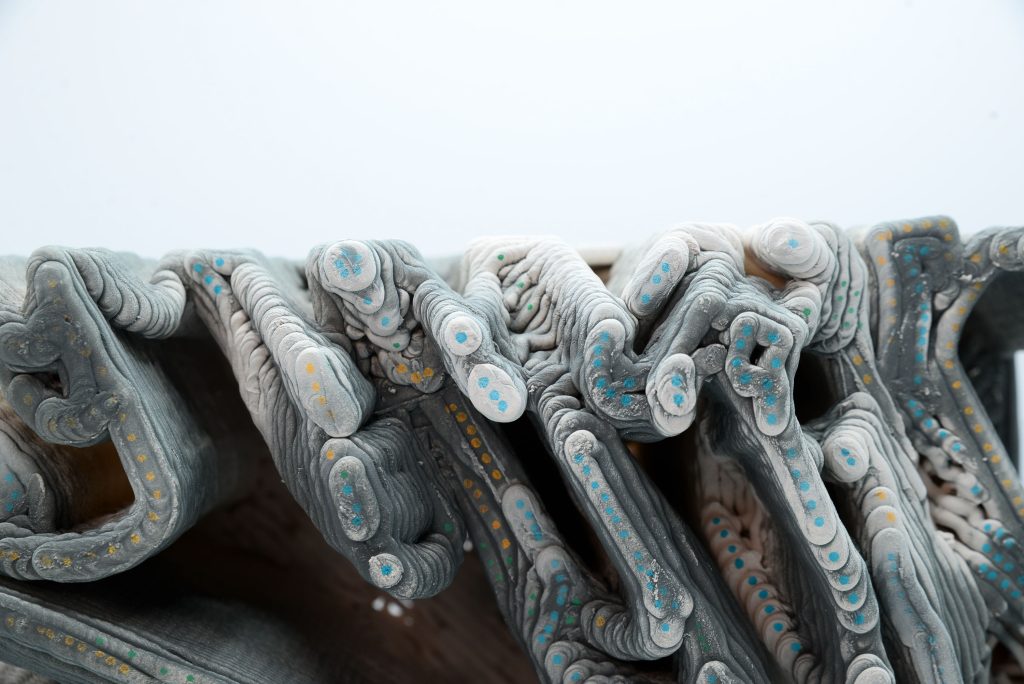
Thermochromic materials are promising for architecture, but their limited UV resistance poses a problem for external applications. Such environmentally responsive smart materials have been studied in various fields ranging from fashion to product design and architecture. Building on previous research by the author, the project aimed to overcome the limitations of thermochromics by exploring heat transfer through solids from external to internal … more

Environment-Responsive Materials as Dynamic Markers for Architectural Augmented Reality Applications
Research project led by Theresa Uitz and Andreas Körner (2021-2022)
With the awareness of our environmental responsibilities growing, architects must engage with alternative design strategies and techniques to express thermal comfort characteristics that are unseen with the naked eye and their inherent spatial features.


Augmented Reality (AR) is a digital technology that allows real events to be virtually augmented by overlaying real data with digital data. As an emergent technology, … more

Postdigital Natures of Planet B is a large-scale, robotically 3D-printed 1:1 installation made of recycled plastic and other bespoke biodegradable materials. It proposes artificial-natural, physical-virtual, technological-botanical hybridity as metaphor for a future vision of a more intricate rapport between architecture and nature I the Anthropocene. It does this by exploring ambiguous overlaps and interfaces between the natural, the virtual, and the built environments. The installation was developed for and exhibited at the ARS Electronica Festival 2022 by the PDNB research … more
 In case you want to change your privacy settings (e.g. issue consent or revoke an already issued consent) please click on the button below.
Settings
In case you want to change your privacy settings (e.g. issue consent or revoke an already issued consent) please click on the button below.
Settings